
By Nate Oliver, Special to NY Hockey Online
Photo courtesy of John Boutet
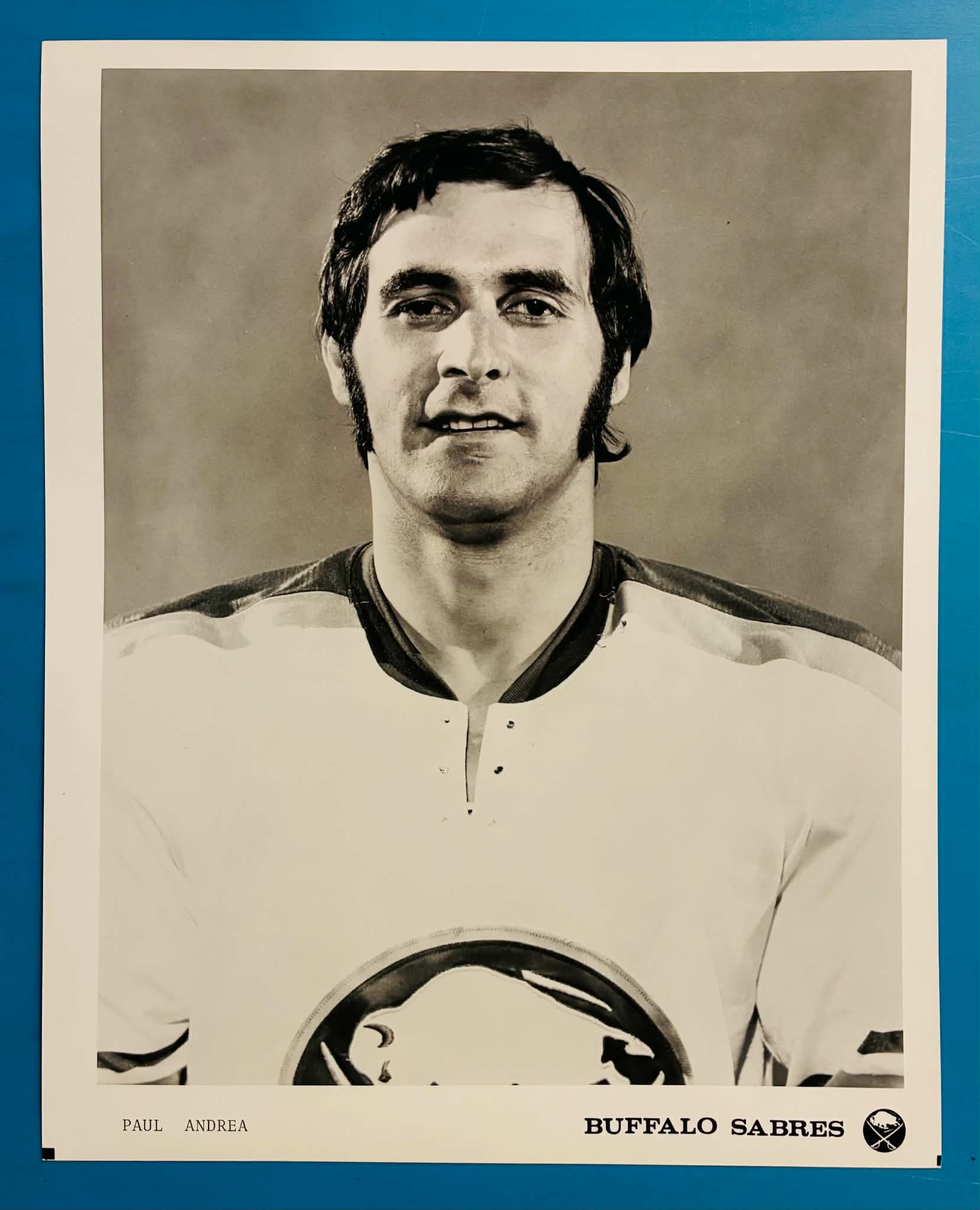
An NHL veteran of four seasons and an original member of the Buffalo Sabres, Paul Andrea is softspoken and humble. While he recalls many fond memories of the teams he played for and his teammates in those cities – certainly including that inaugural year of the Sabres – he doesn’t seek the limelight by any means. But when asked, the soon-to-be 85-year-old from North Sydney, Nova Scotia is gladdened to share, and in great detail mind you. Rest assured that there are numerous interesting tidbits that longtime Buffalo Sabres fans and hockey historians will relish in when it comes to Paul Andrea.
Andrea played 150 regular season games in his NHL career which began during the 1965-66 season with the New York Rangers. He appeared in four games for the Blueshirts that February 1966 while picking up a goal and an assist. It wouldn’t be until the league expanded from six to 12 teams in 1967 that Andrea would become an NHL regular.
The same day as “The Great NHL Expansion” draft on June 6, 1967, Andrea would be traded from the Rangers along with Dunc McCallum, George Konik and Frank Francis to the Pittsburgh Penguins in exchange for defensive-forward Larry Jeffrey who Pittsburgh drafted earlier that day from the Toronto Maple Leafs.
And just like that, Paul Andrea would become an original member of the Pittsburgh Penguins, not knowing at the time that three years later he would also become an original Sabre. In the first year of the Penguins, Andrea went 11-21-32 for scoring in 65 games during the 1967-68 season. Between that first Penguins season and following up with 1968-69, he would play alongside four others who would eventually become original Sabres too – Jean-Guy Lagace, Tracy Pratt, Doug Barrie, and goaltender Joe Daley.
Maybe not a foreshadowing per se, but here is where things begin to take an interesting turn as it relates to Buffalo Sabres history.
Andrea stepped outside of the NHL when he played the 1969-70 season with the Western Hockey League’s Vancouver Canucks; the precursor to the NHL’s version. The Canucks at the time were partially owned by the great Punch Imlach and Joe Crozier – both of whom would become paramount in Sabres’ lore, more imminently Imlach starting with 1970-71.
With Crozier serving as Vancouver’s head coach, he helped lead the club to a 42-14-7 record. Andrea finished second in Canucks’ scoring with 44 goals (tops on the team), 47 assists and 91 points behind only Hockey Hall of Famer Andy Bathgate. Going 5-7-12 in 11 playoff games, Andrea helped Vancouver win their second straight Lester Patrick Cup.
A brief but interesting Sabres nugget – for five games during the Canucks championship season, one of Andrea’s teammates was the right winger for “The French Connection”, Rene Robert.
For the following 1970-71 season, the NHL would add their edition of the Canucks and the Buffalo Sabres as their two newest expansion teams. While Andrea would be claimed by the Oakland Seals on June 8, 1970 in the intraleague draft, it was his former Vancouver head coach Joe Crozier who proved to be a seer or at least had some insider knowledge.
“I had a pretty good year (with Vancouver),” Andrea recalled. “Oakland had drafted me (in the intraleague draft). Before I got drafted though – around the end of the 1969-70 season – our coach Joe Crozier came to me and said, ‘You’re going to go to Buffalo’. I said, “No, no – I’m going to go to Oakland.’ Joe said, “No, no – Punch wants you in Buffalo, so you’ll be going to Buffalo’. I couldn’t see it, but I got drafted by Oakland and I went to Oakland.”
Andrea began the 1970-71 season in Oakland, who were rechristened from the Oakland Seals to the California Golden Seals starting that season. He would pick up a single goal for the Golden Seals against his former Pittsburgh Penguins team on October 23, 1970. It would be Andrea’s only goal and only point with California in nine games.
Beginning on October 30, 1970, things would suddenly become a whirlwind for Andrea and his family. Someway, somehow it was all intertwined with a bit of irony, a bit of coincidence, and likely a bit of orchestration on the part of the masterful Imlach.
“I wasn’t sure I was going to Buffalo,” he went on to say. “But after a month, it turns out that California put me on waivers and I don’t know if that was because of what Punch wanted or not, but I said to myself ‘How the hell did he know that I was going to go to Buffalo?’.”
Andrea’s last game as a Golden Seal was in Oakland on October 30 against the visiting Sabres. On November 3, the Sabres claimed Andrea off of waivers. Not even a full two days later, he would find himself on the completely opposite side of the continent and suiting up for the Sabres on November 5 in Buffalo against the visiting Vancouver Canucks. Imagine the turnaround and the journey.
“I had just settled in Oakland,” Andrea recalled. “I had my family come out. We’re in Nova Scotia and to go to Oakland you’re probably looking at 4,500-5,000 miles. My wife and I, and we had two boys and a daughter at the time – Darren, Jimmy and Verna Lynn. We had an apartment and everything. And after a month I find out that I’m heading to Buffalo.
“It was a tough transition to go from Oakland after having just been there for a month and going to Buffalo. Not that I didn’t want to go to Buffalo or any other NHL club, but it was just when you have a family and you’re moving like that, it’s not only difficult on me but it’s also very difficult on your family. I’m going from 75-78 degrees in Oakland down to Buffalo which was ‘Hello, Mama’.” It wasn’t bad when I first got there but as you know being in Buffalo we get a lot of snow.”
In his very first game as a Buffalo Sabre, Andrea was awarded the first ever penalty shot in Buffalo Sabres history. It would be an unsuccessful attempt against Canucks goaltender Dunc Wilson in what would be a 4-1 Vancouver win at Memorial Auditorium. Regardless, Andrea’s name is etched in the Sabres record books for all of time with this unique fact.
George “Punch” Imlach was 52 years old when he became the inaugural head coach and general manager of the Sabres. By that time, he had already won four Stanley Cups as head coach of the Toronto Maple Leafs and did so in a span of only six seasons. Imlach was widely viewed as a great hockey mind who had a penchant for winning while also being very hard-driving. His joining the fledgling Sabres gave them credibility right from the start.
Imlach’s modus operandi in Toronto was the same as what he would apply in Buffalo by assembling a blend of highly accomplished veterans and talented youngsters. With the Sabres, Imlach would have the great fortune of winning the top overall selection in the 1970 NHL Amateur Draft and selecting Gilbert Perreault who would become the greatest player in the franchise’s history. Imlach would also select Butch Deadmarsh (15th overall) and Randy Wyrozub (43rd oveall), both of whom would debut during the inaugural 1970-71 Sabres season as well.
In fact, when Andrea arrived in Buffalo, his initial linemates were Wyrozub and 20-goal-scorer Steve Atkinson. Andrea’s first goal as a Sabre would ironically come against the Golden Seals who were visiting Buffalo’s venerable “Aud” on November 13. Atkinson and Wyrozub would pick up the primary and secondary assists on the goal respectively.
“Of course I had to meet all those guys,” Andrea said. “Having just gotten close to a lot of guys in Oakland and now I’m going to Buffalo, I didn’t know a whole lot of those guys. I knew some of them because I had played with and against some of them before. Knowing the guys I had played with, that was easy. But getting to know the other guys, it takes a while to gel and of course playing on a line with Randy and Steve, it’s all new so you try to find one another. How their game is played and how your game is played. Where you can get in the open and where you have to backcheck – the whole ball of wax. That takes time no matter whether it’s me or anybody else.”
Where Andrea immediately earned both success and confidence with his newfound team was on the power play. Imlach’s trust in the 29-year-old forward saw him placed into the vital role of quarterbacking the point whenever the Sabres had the man-advantage.
“Punch had me on the power play and I played the point,” Andrea remembered. “That was a big boost to my confidence to have Punch put me on the power play when I just got there. That was a good experience and that was good for my morale. Phil Goyette played center, and Gilbert Perreault played the wing and so did Eddie Shack. Phil would always say, ‘Give
me the puck. I’ll get the puck over the blue line and set things up’, and eventually he’d get it to Gilbert Perreault. Phil was the catalyst on the power play because he was such a smooth hockey player. Super nice guy, great guy to play with.”
The 1970-71 Sabres’ power play ranked sixth in the NHL among the 14 teams. Much of that success could be attributed to Goyette – who at age 37 averaged better than a point-per-game season (15-46-61 in 60 games) – and rookie sensation Perreault who set the NHL’s rookie goal-scoring record that season with 38 goals in 78 games.
But accolades need to be given to Andrea’s work from the point. In his 47 games for “The Blue and Gold” that first season, he registered 11 goals, 21 assists and 32 points in only 47 games. What is perhaps most noteworthy though is that 14 of Andrea’s 21 assists came on the power play – that trailed only Goyette (19) and Perreault (15) on the team for power play helpers; both of whom played in many more games than Andrea whose season got cut short with a March injury.
“I got hurt in the first part of March,” Andrea recalled. “We were playing against Toronto, and I was going around Rick Ley and he stuck his knee out and caught my knee. I tore all the ligaments in it, so I was gone for the rest of that season. I don’t know what I would’ve done further offensively if I had finished out the season. That was kind of my downfall in Buffalo when I got hurt.”
Statistics aside for a moment, Andrea has great recollections of his teammates from that season.
“When Randy Wyrozub was sent down to Salt Lake in November, I then got to play on a line with Gilbert Perreault. He, myself and Eddie Shack played on a line together and that was interesting,” Andrea laughed. “Gilbert was a quiet kid. Shack took him under his wing but would also drive him crazy, and he’d have a lot of laughs with Shack.
After the Sabres acquired Shack from the Los Angeles Kings in a trade on November 25 that also brought them Hall of Famer Dick Duff, Shack would score 25 goals playing alongside Perreault in only 56 games for the Sabres.
“Shack was a little on the crazy side,” Andrea recalled with affection. “I can remember in the middle of winter it snowing out and we were going back home because he lived not too far from where I lived. We lived across the bridge in Fort Erie. We were going down Main Street in Buffalo with the top down on the car and it snowing. But that was him. He was a little on the crazy side. As you know, Shack couldn’t read or write. The only thing he could do was sign his name. Anytime he needed money or anything, he had to call his lawyer in Toronto. I think he went through three or four skidoos that year because we had a lot of
snow. Apparently from what I hear, a lot of parents at that time when they knew we were in town they wouldn’t let their kids out because Shack was on his skidoo and he was crazy.”
Asked about the specialness of his younger linemate Perreault, Andrea could see the (slightly raw at the time) greatness within him right from the get-go.
“Gilbert was special,” Andrea said. “The first time that I got a chance to play with him and the first time I got to watch him, I knew. I think Connor McDavid from Edmonton reminds me a lot of him. I say that as when McDavid comes down on a defenseman he doesn’t coast, he comes around him full speed. That’s the way that Gilbert was. He could come down on a defenseman and wouldn’t stop to make a deke. With his speed and the way he could handle the puck he’d go around them. He was a very exciting player.”
Bearing in mind that Perreault was a mere 20 years old that first season, Andrea went on to say “Gilbert had a lot to learn when he was at that age. I’m not knocking him or anything but at that time he kind of held onto the puck a little too much. When someone was near him he’d try to stick handle by them or stuff like that. When he couldn’t get by them he would try to stick handle rather than move the puck. He had to learn that and eventually he did learn that. He eventually played with two great guys with Martin and Robert. They were a great line – “The French Connection”. So he did learn and he became even that much better than he was before.”
When asked who the most valuable player was for the Sabres that first year, Andrea unsurprisingly bestowed the honor upon the Sabres’ star rookie.
“Roger Crozier certainly played very well, and he was under a lot of pressure,” he said. “But with Gilbert Perreault in his first year, you could see the stardom in him with the way he played and the way he handled himself. You knew that he was going to be the face of the franchise as far as I was concerned, and that’s the way it turned out too. He was just that good.”
Including Shack, and owing to Imlach’s penchant for having veteran leadership as his cornerstone, the inaugural Sabres had seven players who were 34 years old or older. Between them, 27 Stanley Cups had already been won: Shack (four Stanley Cups), Duff (six), Goyette (four), Donnie Marshall (five), Jean-Guy Talbot (seven), Reggie Fleming (one). The Sabres first captain Floyd Smith was the only one of the aged guard not to have won a Cup.
Andrea was one of the few exceptions on the team who was neither a youngster like Perreault or Wyrozub, but neither was he in his golden years as were Goyette, Duff, Marshall, etc.
“Punch was very loyal to the guys that played for him in Toronto,” Andrea recalled fondly. “Dickie Duff, Floyd Smith, and Shack. He was pretty loyal to those guys. Not that they got to run anything, but they probably got closer to Punch than anybody else.”
“Jean-Guy Talbot was a fun guy who was always doing something funny in the dressing room. Nailing someone’s shoe to the floor or half a bag of powder in your shoes or socks. Always doing something. He was pretty loose that way”
Having Goyette and Marshall on the team was practically like having two player-coaches who really lent a hand to Imlach and provided tutelage to the youngsters. At age 38, Marshall was the oldest Sabre on the team and still was able to put up 20 goals and 29 assists for 49 points in just 62 games.
“Actually, Donnie Marshall ran quite a few practices for Punch,” Andrea explained. “Punch would sit up in the stands a lot of times. He didn’t do it all the time, but when he wasn’t there Donnie Marshall used to run the practices.”
The hard-nosed Imlach did not win four Stanley Cups by taking it easy. He was tough and demanding but was also known for his commitment to his players.
“I don’t know that anybody had a real good relationship with Punch,” Andrea offered. “He was always affable and nice but it’s hard to get close to your coach. He had a reputation for being a tough coach. I didn’t really see that. He was probably at the end of his career too. Punch could be tough in practice too. He’d make you skate. And of course, with Shack there he would just try to drive Punch crazy. We would be going up and down, and Punch would say something, and Eddie would say ‘Is that all you’ve got for us?’. And of course we’d all be cursing, ‘Shut your mouth, Eddie! We don’t want to be going back and forth all the time’. Eddie was a big strong guy, so he didn’t mind it.”
Andrea’s closets friends on the team were his original linemate Steve Atkinson and talented defenseman Al Hamilton. For both the 1970-71 and 1971-72 seasons, Hamilton was the leading scorer among all Sabres blueliners (2-28-30 in 69 games and 4-30-34 in 76 games respectively). Andrea and Hamilton had been teammates together with the New York Rangers, as well as minor league teams with the St. Paul Rangers and the Omaha Knights prior to their time in Buffalo.
“When we were on the road I usually hung out with either one of those guys,” Andrea said. “Whether we went for something to eat or to a movie, they were probably my closest friends at that time in Buffalo.”
Following the completion of that first season in Buffalo, Andrea felt that he had lost a step from his injury as he headed into the Sabres’ sophomore season of 1971-72.
“In those days,” he recalled. “I never had a trainer to help me out to patch my leg back up and strengthen it. We had no ice down here in the summertime, so my workout was that I did a lot of running around town just to get in shape. When I went back to Buffalo, I wasn’t strong on my skates and Punch could probably see that. He said to me, ‘I’m sending you to Cincinnati for a couple of weeks. When you get stronger, we’ll take you back’. The unfortunate thing is that he never took me back.”
The owners of the Sabres – Seymour and Northrup Knox – exercised their option to create their own American Hockey League affiliate. Initially wanting to base the team in South Florida, the Knoxes eventually decided to put the team in Cincinnati and christened them the Swords beginning with the 1971-72 AHL season.
Andrea was a vital cog for the early success of the Swords. He led the club in both assists (58) and points (72) in 69 games in the Swords’ first season. Andrea would add another 11 points (5-6-11) in 10 postseason games that season as well.
“Joe Crozier was coaching Cincinnati,” Andrea said. “Joe had obviously coached me in Vancouver and knew what I could do to help the team. I think that might have had a little to do with why I never got called up to Buffalo. Those are my own thoughts at least. I think Joe wanted me to stay in Cincinnati because I was a leader there. I played on the power play, killing penalties and my own regular shift when I was in Cincinnati, so I was a big part of their team. I keep thinking that he didn’t want me to leave because I was having a good year and Buffalo could’ve called me up very easy but unfortunately it never happened.”
NHL players made very modest salaries in the early 1970s. As is the case for most, taking care of your family and paying the bills comes first. When the NHL’s rival – the World Hockey Association (WHA) – began with the 1972-73 season, Andrea made the jump to the new league in order to better secure his family. This would mark the end of his time with the Buffalo Sabres organization.
“The Cleveland Crusaders (of the WHA) sent me a plane ticket and wanted me to come out so they could meet me, which I did,” Andrea recalled. “I got to negotiate with them about a contract. So in Buffalo at that time, I was making $15,000 which is not a whole lot of money. When I went to the WHA, they offered me $50,000 and $55,000. I had a family, I had three at the time, so you’re looking at $15,000 compared to $50,000. There’s no comparison. We weren’t making the money then. So, I signed with Cleveland.”
As fate would have it, Imlach and the Sabres did wish to retain Andrea but the timing had been slightly out of synch and financial compensation was not in the same ballpark.
“When I got home from Cleveland, I got a call from Punch,” Andrea shared, “Punch said ‘I’d like you to sign a three-year contract with the Sabres.’ I said, ‘Well Punch, I just got back
from Cleveland and they wanted me to sign with them.’ He said, ‘What did they offer you?’, and so I told him what they offered. Punch said, ‘No, no – I can’t go that high. I’ll give you $30,000 and $35,000.’ So I said, ‘Well, I’ve already signed, so I’m sorry.’ Looking back, at that time if Punch had called sooner I probably would’ve signed with Buffalo. Anyway, I ended up in Cleveland and missed out on two or three years with Buffalo.”
“Looking back, I would have loved to have stayed in Buffalo for a couple more years but unfortunately when you have a family and you’re looking at your expenses and everything else, that’s why I went to Cleveland and that’s why I signed with the Crusaders.”
Those Cleveland Crusaders were not too shabby either. Hockey Hall of Famer Gerry Cheevers tended the Cleveland net. Andrea – who tallied 21 goals, 30 assists, and 51 points in 66 games that season – was one of six Crusaders to hit the 20-goal plateau. Another original Sabre – Skip Krake – joined Andrea with the Cleveland club. Similarly, his former Golden Seals teammates Gary Jarrett, Joe Hardy and Wayne Muloin ended up there as well.
Following two seasons with the Cleveland Crusaders, Paul Andrea would retire from professional hockey after the 1974-75 season with Cape Codders of the North American Hockey League.
It is close to 60 years since the first season of the Buffalo Sabres. Many players have come and gone, and yet Andrea’s memories from that first season remain vivid. Furthermore, he has no regrets and looks back on his time with the Sabres with heartfelt fondness.
“I really enjoyed my time in Buffalo,” Andrea parted with. “I got to play with guys like Donnie Marshall, Dickie Duff, and those guys, and that’s always an experience. You learn from them because they’ve won. Dickie Duff, Donnie Marshall and Phil Goyette won a number of Stanley Cups. They were real hockey guys. They knew how to handle themselves, and knew when to do what when, so you learn from that. Although I was a little older, they certainly made an impact on my hockey career.”
There are ripple effects that permeate throughout hockey and throughout life. Everything is intertwined. So while Andrea is indeed humble and softspoken, the importance of his contributions to Sabres history and that first team cannot be overlooked. Playing alongside a rookie Hall of Famer in Gilbert Perreault, being a trusted point man for Punch Imlach who would see his team in the Stanley Cup Final only five years later, riding with the top down in the dead of winter with “The Entertainer” Eddie Shack, taking the first penalty-shot in Sabres history… whatever nugget it might be, Paul Andrea was quintessential to securing a passion for Sabres hockey in Buffalo that exists to this day. Longtime Sabres fans shall always remember him most fondly.


